

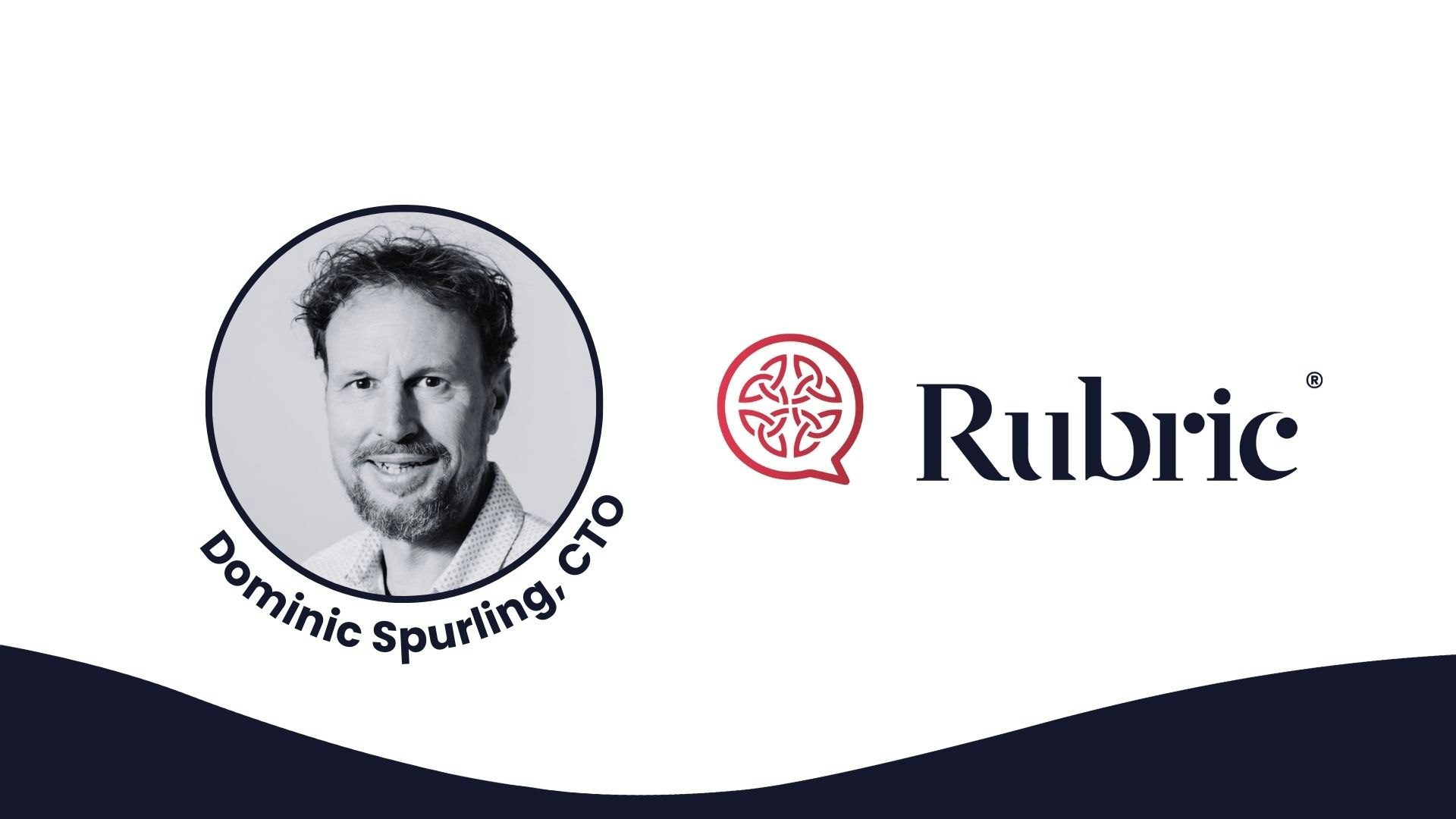
At Rubric, we’re always evolving our business to better respond to our clients’ needs. And, as an employee-owned company with a strong focus on continuous improvement, we love to see our colleagues develop their careers with us as they help clients succeed. With this in mind, we’re thrilled that Dominic Spurling, previously our IT Director, has been named as Rubric’s Chief Technology Officer (CTO).
Dominic has worked at Rubric for seven years, taking the lead in developing custom tools and solutions that make localization easier, cheaper, and more effective for global businesses. His deep understanding of our systems, our clients, and the challenges facing our industry enable him to deliver next-generation localization solutions built around client needs.
Dominic’s appointment as CTO is a step forward in Rubric’s strategic and technological leadership, positioning us to accelerate innovation and increase value for clients. His forward-thinking approach integrates automation to reduce manual effort, while maintaining the human oversight that protects client brands and drives ongoing quality improvements.
We asked Dominic a few questions to find out more about his vision and the role of technology in helping our clients deliver on their global content strategies.
1. How do you make sense of current times within the localization industry?
It’s a period of rapid change—for clients, that can feel uncertain. There’s pressure to move faster, scale further, and reduce costs, all while protecting brand, quality, and security.
Some clients are betting that AI is now good enough to translate much of their content without human review (post editing) and that is a big shift economically.
For language experts, the focus has become more strategic and has shifted upstream: developing terminology, making branding decisions, and defining content governance rules that will stack the odds in favour of good outputs from AI pipelines.
2. What three words do you think will shape 2026 in the localization industry?
- Opportunity
Localization is increasingly seen as a strategy to engage global audiences, not as a downstream cost. - Governance
We need pipelines that provide AI with context, surface risks, and keep language experts in the driving seat. - Scalability
As AI speeds up translation, disconnected processes become the new bottleneck. Scaling up depends on integrating the full content workflow end to end.
3. What are the biggest challenges clients are facing right now, and how will your tech strategy support them?
Clients are being asked to do more with less, while expectations around speed, quality, and security continue to rise. Many are also struggling to demonstrate clear ROI from their technology investments, particularly around AI.
Mis-sold AI capabilities can lead to initiatives going off the rails and we are increasingly being asked to step in when this happens. For example, content platforms can easily add stock translation models, but these don’t provide enough flexibility to work in every domain. To address this, we integrate our content governance framework, which ensures technically accurate, on-brand translations and highlights areas of risk.
4. What developments are you most excited about for clients this year?
The pace of change driven by AI is encouraging more clients to take a strategic view of localization. Rather than being viewed as a downstream cost, localization is increasingly being recognized as a core part of go-to-market strategy — a transformation in mindset that we have been helping clients to bring about within their organizations since Rubric was founded over 30 years ago.
One of the most exciting areas for us is solutions integration. We’re helping clients better connect their translation management systems with their content platforms and broader technology stack. When clients trust us with what one described as “the whole enchilada,” we can optimize every aspect of their multilingual content operation, from authoring and content preparation through to version control and publishing.
Take product names, for example. Clients might ask us not to translate them, but then we find they’ve been translated elsewhere in the company. In other cases, it turns out a product name exists in another context or has been used as a description. When we’re involved from the start, we can help identify these ambiguities and establish clear rules and checking procedures. Integrating that governance enables the AI to work more effectively, so you get a better customer experience with less rework and a faster time to market.
We helped one client cut their localization costs by 75% and improve quality at the same time. This was possible because they had a large volume of existing material of unknown quality, and we were able to put that through the same QA guardrails that we developed for processing new content using AI.
5. What role will client feedback play in shaping your technology roadmap?
We always welcome “explicit” feedback from clients, where they flag up specific issues to fix or changes we should be aware of. More often, though, we’re guided by “implicit” feedback that emerges as we continually review, compare, and improve.
This works when we have full visibility of a client’s content pipeline, so when anyone makes a change on their side—say, a marketer switches a brand term, or a developer fixes a bug—we can automatically pick that up and ensure it’s reflected across all languages. We also feed these updates back into content governance rules so the translation will be correct next time.
Our automated QA tools do a lot of the heavy lifting, but our human-at-the-core approach is what sets us apart. Changes are managed in collaboration with the client to minimize disruption and improve future outcomes. We’ve always invested in long-term client relationships, and being able to maintain (and improve) their multilingual content over time is a key part of that.
That’s why our technology roadmap features a new platform which is focused on looking after our clients’ assets, rather than being purely process-driven like others in the industry. It’s about working in partnership with our clients to help them optimize their content for localization, while integrating strong, continuous feedback loops that mitigate risk and keep improving quality.
Technology is part of Rubric’s DNA, and we’re excited to develop our capabilities even further under Dominic’s leadership. If you’d like to learn more about incorporating technology—including AI translation—into your global content pipeline, talk to us. Dominic and the team are here to build you a solution that’s integrated into your ecosystem, with human oversight and guidance for long-term quality. So you can scale faster with AI, while protecting your brand and keeping costs in check.